Roofing Options
How Long Does a Roof Last in West Michigan? Roof Life by Material
The West Michigan Storm & Roof Report — Entry #2
In West Michigan, an asphalt shingle roof typically lasts 15–25 years, metal 40–70, cedar 20–35, and composite 30–50. Those are directional ranges, not promises — because around here, freeze-thaw cycling, lake-effect snow, and wind-driven UV exposure age roofs faster than the brochure numbers suggest. Where your roof lands inside its range depends less on the material and more on how it was installed and ventilated.
I'm Aaron Niedzwiecki, owner of Grandville Roofing & Exteriors in Comstock Park. Our crews have been putting roofs on West Michigan homes for more than 50 years, and we're employee-owned — the people quoting your roof are the same people who answer for it later. This is the second entry in our Storm & Roof Report series. Entry #1 covered what summer storm season does to local roofs; this one covers how long each roofing material actually holds up here, and how to tell whether yours is done or just middle-aged.
Why Do Roofs Age Faster in West Michigan?
Roofs in West Michigan age faster than national averages because of three local stressors: freeze-thaw cycling, lake-effect snow load, and concentrated wind and UV exposure on west- and south-facing slopes. Any lifespan number you read needs to be filtered through those three before it means anything for your house.
Freeze-thaw cycling
Our winters don't just get cold — they bounce. Temperatures cross the freezing line over and over from late fall into spring. Every crossing matters: meltwater works into tiny gaps around fasteners, flashing, and shingle seams, then freezes and expands, prying those gaps a little wider. Repeat that for a couple of decades and small manufacturing tolerances become leaks. Freeze-thaw is hardest on materials that absorb moisture (cedar, aging asphalt) and easiest on materials that shed it (metal).
Lake-effect snow load
Lake Michigan gives us snow in quantities most of the country never has to design around — and lake-effect snow is often wet and heavy. That weight stresses decking and fasteners, and when it melts unevenly over a poorly ventilated attic, it forms ice dams that push water backward under shingles. Snow load doesn't usually destroy a roof outright. It shortens the roof's life quietly, one winter at a time.
West- and south-slope wind and UV
Walk around almost any older home in Kent County and you'll see it: the west and south slopes look years older than the north side. Those slopes take the prevailing wind off the lake plus the most direct sun. Wind lifts and fatigues shingle edges; UV dries out the asphalt binder and makes shingles brittle. It's common for one slope to be genuinely worn out while the rest of the roof has life left — which matters when you're deciding between repair and replacement.
How Long Does an Asphalt Shingle Roof Last in West Michigan?
Expect 15–25 years from an asphalt shingle roof in West Michigan — three-tab shingles at the low end of that range, architectural (dimensional) shingles at the high end. Asphalt is the most common roof in the region for good reason: it delivers the most protection per dollar. But it's also the material most sensitive to our climate.
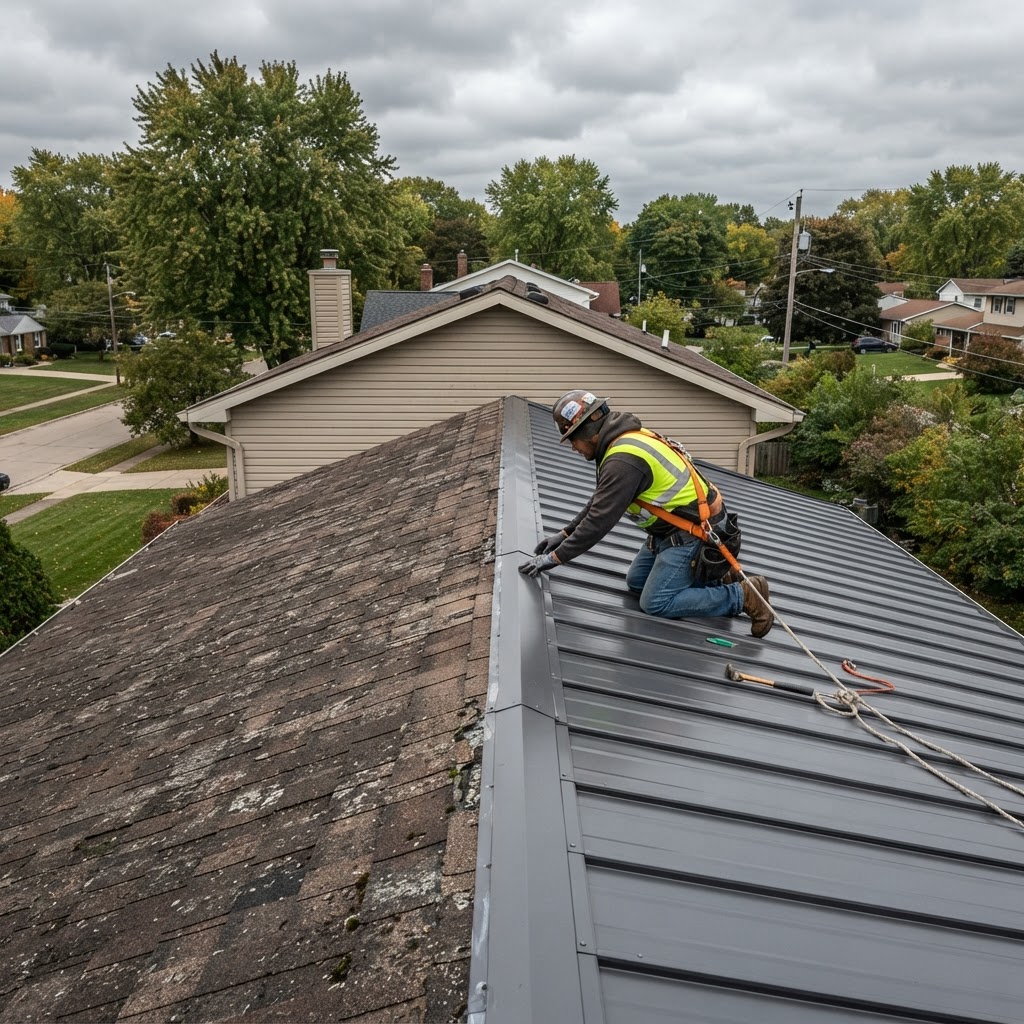
Three-tab shingles are lighter and flatter, with less material to sacrifice to UV and wind fatigue, so they age out first — especially on those west and south slopes. Architectural shingles are thicker, heavier, and better anchored, which is why they hold the top of the range. Signs an asphalt roof is nearing the end: heavy granule loss in the gutters, curling or cupping edges, cracked or missing tabs, and shingles that feel brittle rather than pliable.
One honest caveat: those years assume proper attic ventilation. A poorly vented attic cooks shingles from below in summer and feeds ice dams in winter, and it can take years off the low end of that range. More on that below, because it's the single most common problem we find.
How Long Does a Metal Roof Last in West Michigan?
A properly installed metal roof lasts 40–70 years in West Michigan, which makes it the longest-lived mainstream option for our climate. Metal handles the three local roof agers better than anything else: it sheds snow instead of holding it, it doesn't absorb water so freeze-thaw has little to grab onto, and its finishes resist UV far longer than asphalt binder does.
For many homeowners, a metal roof is a "last roof you'll ever buy" decision. The trade-offs are up-front cost (covered in the cost section below) and installation skill — metal is unforgiving of shortcuts. Panel fastening, expansion allowance, and flashing details have to be right, because a metal roof that's installed poorly won't deliver metal-roof longevity. If you're comparing metal against architectural asphalt, the honest framing is: asphalt costs less now, metal costs less per year of service, and the right answer depends on how long you plan to own the home.
How Long Does a Cedar Roof Last in West Michigan?
Cedar shakes and shingles last 20–35 years in West Michigan — but only with honest, ongoing maintenance, and that caveat is doing real work in this sentence. Cedar is a natural material in a climate that's hard on natural materials. Without upkeep, a cedar roof here will not see the top of that range, and may not see the middle.
Cedar's enemy in West Michigan is moisture. Our humidity, snow cover, and shaded lots encourage moss, lichen, and rot, and freeze-thaw cycling splits shakes that have absorbed water. Keeping cedar healthy means regular cleaning, keeping debris out of the keyways, treating for moss, and replacing split or cupped shakes promptly instead of letting water find the underlayment. Homeowners who love the look and accept the maintenance get a beautiful roof with a respectable life. Homeowners who want to ignore their roof for a couple of decades should be steered — honestly — toward architectural asphalt, composite, or metal. We'd rather tell you that before you buy than after.
How Long Do Composite (Synthetic) Shingles Last?
Composite or synthetic shingles last 30–50 years in West Michigan, putting them between architectural asphalt and metal. Engineered from polymer blends, composite products are built to mimic cedar shakes or slate while shrugging off the moisture problems that shorten real cedar's life here.
Composite handles our climate well: it doesn't absorb water the way wood does, so freeze-thaw has less to work with, and modern formulations carry strong impact and UV resistance — useful on hail-prone, sun-beaten south slopes. The trade-off is cost, which sits above asphalt, and the fact that product lines vary widely in quality. If you're considering composite, ask specifically about the impact rating, the fade warranty, and the manufacturer's track record, because "composite" covers a wide range of products and the ranges above assume you're buying a reputable one.
What Actually Determines Where Your Roof Lands in Its Range?
Installation quality and attic ventilation are the real variables behind every range in this article. Two identical bundles of architectural shingles can produce a roof that fails early or one that reaches the top of its range — same material, same street, different installer. The material sets the ceiling; the workmanship decides how close you get to it.
Ventilation is the quiet one. Your attic needs balanced intake and exhaust so it stays close to outdoor temperature year-round. Get it wrong and summer heat bakes shingles from underneath while winter heat loss melts snow that refreezes into ice dams at the eaves — both of the region's biggest roof-killers, accelerated by your own attic. When we inspect a roof that "failed early," inadequate ventilation is the most common root cause we find.
Installation is the rest: nailing pattern and placement, ice-and-water barrier coverage at eaves and valleys, flashing details at chimneys and walls, and starter courses done right. This is why Grandville Roofing & Exteriors maintains the CertainTeed ShingleMaster credential — it means our installation practices are trained and vetted against the manufacturer's own standards, not just local habit, and it lets us offer stronger manufacturer-backed warranty coverage on CertainTeed systems. A warranty is only as good as the installation underneath it.
How Much Does a Roof Replacement Cost in West Michigan?
Directionally, a full asphalt roof replacement on a typical West Michigan home runs $10,000–$25,000, depending on the size and complexity of the roof, the shingle line you choose, and what we find in the decking once the old roof comes off. Metal runs roughly 2–3x the cost of a comparable asphalt roof — we won't pretend to more precision than that, because no honest number exists until someone measures your actual roof.
Where your project lands in that range comes down to square footage, pitch, the number of valleys, chimneys, and penetrations, tear-off findings, and material grade. The only way to turn a range into a real number is an on-site measurement and inspection. If you're starting to gather numbers, our roof replacement in Grand Rapids and roof replacement in Walker pages cover what the process looks like in those communities, and a no-pressure quote costs you nothing.
Is Your Roof Done — or Just Mid-Life?
An aging roof isn't automatically a dead roof. A roof partway through the ranges above with localized problems — a storm-damaged slope, worn flashing, a few failed shingles — is often a repair candidate, not a replacement. A roof at or past the top of its range with widespread wear is a replacement candidate, and repairs at that point are usually money thrown at a roof that's leaving anyway.
The honest test is pattern versus age. Isolated damage on a roof with years left in its range: repair it and move on. Widespread symptoms — granule loss across multiple slopes, brittle shingles, recurring leaks in different places — on a roof near the end of its range: put repair money toward replacement instead. And remember the slope effect: a west-facing slope can be finished while the rest of the roof is fine, which is exactly the kind of judgment call that deserves eyes on the roof rather than a guess from the driveway. We walked through storm damage and the repair-vs-replace decision in detail in Entry #1 of the Storm & Roof Report — if you're weighing that call right now, read that one next.
West Michigan Roof Lifespan FAQ
How long does a roof last in Michigan on average?
Most Michigan homes wear asphalt shingles, so the practical answer for most homeowners is 15–25 years — three-tab at the low end, architectural at the high end. Metal (40–70 years), composite (30–50), and cedar (20–35, with diligent maintenance) all outlast asphalt, at a higher up-front cost.
Does lake-effect snow really shorten a roof's life?
Yes, though gradually rather than dramatically. Lake-effect snow is heavy and frequent, which stresses decking and fasteners, and uneven melt over a poorly ventilated attic creates ice dams that force water under shingles. A well-ventilated, well-installed roof handles our snow; a compromised one ages faster every winter.
Why does one side of my roof look worse than the rest?
West- and south-facing slopes in West Michigan take the prevailing wind plus the most direct UV, so they genuinely age faster than north-facing slopes. It's common for one slope to need attention while the rest of the roof is sound — one reason a slope-by-slope inspection beats a driveway glance.
What shortens a roof's life the most?
Poor attic ventilation and installation shortcuts — more than material choice, more than weather. Bad ventilation overheats shingles in summer and feeds ice dams in winter, while bad nailing and flashing invite wind and water damage. It's why credentials like CertainTeed ShingleMaster matter: the installation determines whether you get the top of the range or the bottom.
Should I repair my aging roof or replace it?
Depends on pattern and age. Isolated damage on a roof with years left in its lifespan range usually merits repair; widespread wear on a roof near the end of its range usually merits replacement. Entry #1 of the Storm & Roof Report walks through that decision in depth.
Is a metal roof worth the extra cost in West Michigan?
Often, yes — if you plan to stay in the home. Metal runs roughly 2–3x the cost of asphalt but lasts 40–70 years against asphalt's 15–25, and it handles snow, freeze-thaw, and UV better than anything else we install. For a shorter ownership horizon, architectural asphalt is usually the better value.
Get a Straight Answer About Your Roof
Ranges are useful; a real answer about your roof requires someone on it. Grandville Roofing & Exteriors is employee-owned, based in Comstock Park, and has served West Michigan for more than 50 years — and we'll tell you plainly whether your roof needs replacement, a repair, or nothing at all yet. Request your free inspection and quote here, and we'll give you the honest version, slope by slope.
Next in The West Michigan Storm & Roof Report: watch the blog for Entry #3.
Explore Our Services
Ready to Talk About Your Roof?
Free inspections for West Michigan homeowners — no pressure, no obligation.