
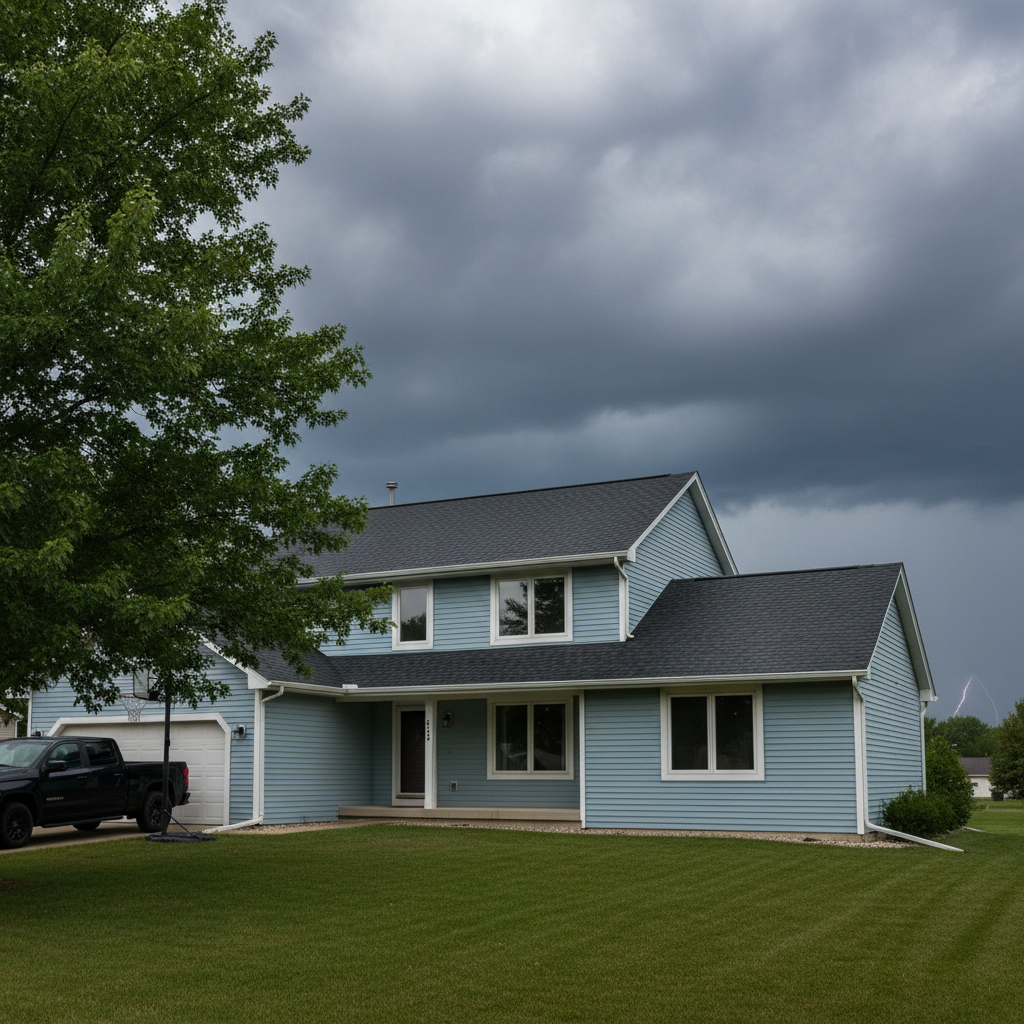
Storm season in Ada arrives quickly and doesn't give much notice. Sitting along the Grand and Thornapple rivers with a lot of mature tree cover, Ada homes face a particular combination during a severe thunderstorm: straight-line wind funneling through river corridors, hail, and heavy limbs directly over rooflines. Preparing your exterior before the season saves money, and more often it saves the far larger cost of water getting inside.
Here is what's worth doing, in the order we'd do it.
Inspect the roof first
Before storm season, look over your roof carefully. You're checking for missing or damaged shingles, lifted edges, worn or separated flashing around chimneys and vents, and any soft or sagging areas.
Winter is what sets this up. Snow load and freeze-thaw cycling loosen fasteners and open small gaps, and then the first hard spring rain finds every one of them. If you're comfortable and the pitch is manageable you can look yourself, but a slope-by-slope inspection from someone who does it daily will catch things a driveway glance won't — particularly on the west and south faces, which age fastest here.
Clear the gutters, then check where the water goes
Clogged gutters are one of the biggest contributors to roof and siding damage in Ada, and with the tree cover around here they clog fast.
During heavy rain, water that can't move through the gutter goes over the edge instead — down the siding, or backward under the roof decking. Clean them before storm season, not after. If you have tall trees close to the house, gutter guards are worth the money purely for how much less often you'll be on a ladder.
While you're at it, confirm the downspouts discharge four to six feet away from the foundation. A clean gutter that dumps straight down beside the house has just moved the problem.
Check the siding, especially the seams
Siding does more than curb appeal — it's the wall's weather barrier. Look for cracks, warping, loose or lifted panels, and above all the caulking at seams and around windows and doors. Those transitions are where wind-driven rain gets in, and wind-driven rain is what a summer storm delivers.
Small repairs now are genuinely small. The same gap after a season of water intrusion is a sheathing conversation.
Trim back what's hanging over the roof
This is the highest-value item on the list for Ada specifically. Overhanging limbs are the most common cause of serious storm damage we see on homes here — not the wind itself, but what the wind throws.
Get branches cut back clear of the roofline before the season. Dead or damaged limbs should come out entirely. It protects the roof, and it's better for the trees.
Have a plan for the power going out
Storms that take down limbs take down lines. Keep a kit somewhere you can find it in the dark: water, food that doesn't need cooking, a flashlight with working batteries, a first-aid kit, phone chargers, and copies of your insurance policy and your contractor's number.
What to check the morning after
This part matters as much as the preparation, because storm damage is frequently invisible from the ground.
Walk the perimeter in daylight. Look for shingle pieces or granule piles in the yard and at downspout outlets, dents in gutters, downspouts, or siding — which usually means hail — and any lifted or missing shingles along the ridge and edges. Inside, check ceilings and upstairs walls for fresh staining, and look in the attic with a flashlight for daylight or damp sheathing.
Photograph anything you find, with the date. If you end up filing an insurance claim, documentation taken immediately is worth considerably more than documentation taken three weeks later.
When to call someone
If you find dents, lifted shingles, or any sign of water inside, get eyes on it before the next storm. Damage that's cosmetic today is an entry point next month.
Grandville Roofing & Exteriors is employee-owned and has worked on homes in Ada and across Kent County for more than fifty years. We'll tell you plainly whether what you're looking at needs repair, replacement, or nothing at all yet — and if it's storm damage, we'll walk you through how the claim process actually works before you file.
Explore Our Services
Ready to Talk About Your Roof?
Free inspections for West Michigan homeowners — no pressure, no obligation.